There is a moment in every porcelain veneer case after which there is no going back. The ADA explains that porcelain veneers involve removing a small amount of enamel from the front and sides of the tooth, and that because enamel is removed, the treatment is not reversible (ADA MouthHealthy, 2026). Everything before that moment is planning. Everything after is execution.
A mock-up, sometimes called a trial smile or test drive, sits right at that boundary. It lets you see, feel and photograph a version of the proposed smile on your own teeth before any preparation happens. For international patients with limited days in Medellín, it is arguably the most valuable appointment of the trip. This guide explains how mock-ups work, what to check, and how to give feedback that actually changes the result.
What a mock-up is (and isn't)
Methods vary between clinics, but the general idea is consistent. The dentist or lab designs the proposed tooth shapes, often starting from photos and a scan or impression. A model of the new smile is produced, and from it a temporary material is shaped over your existing teeth. You walk out of the chair looking roughly like the planned result.
A mock-up is not the final restoration. It is usually a little bulkier, the colour may be a stand-in, and it is not bonded for long-term wear. What it does capture well is proportion: tooth length, width, the curve of the biting edges, and how the teeth sit relative to your lips.
Digital design vs physical mock-up
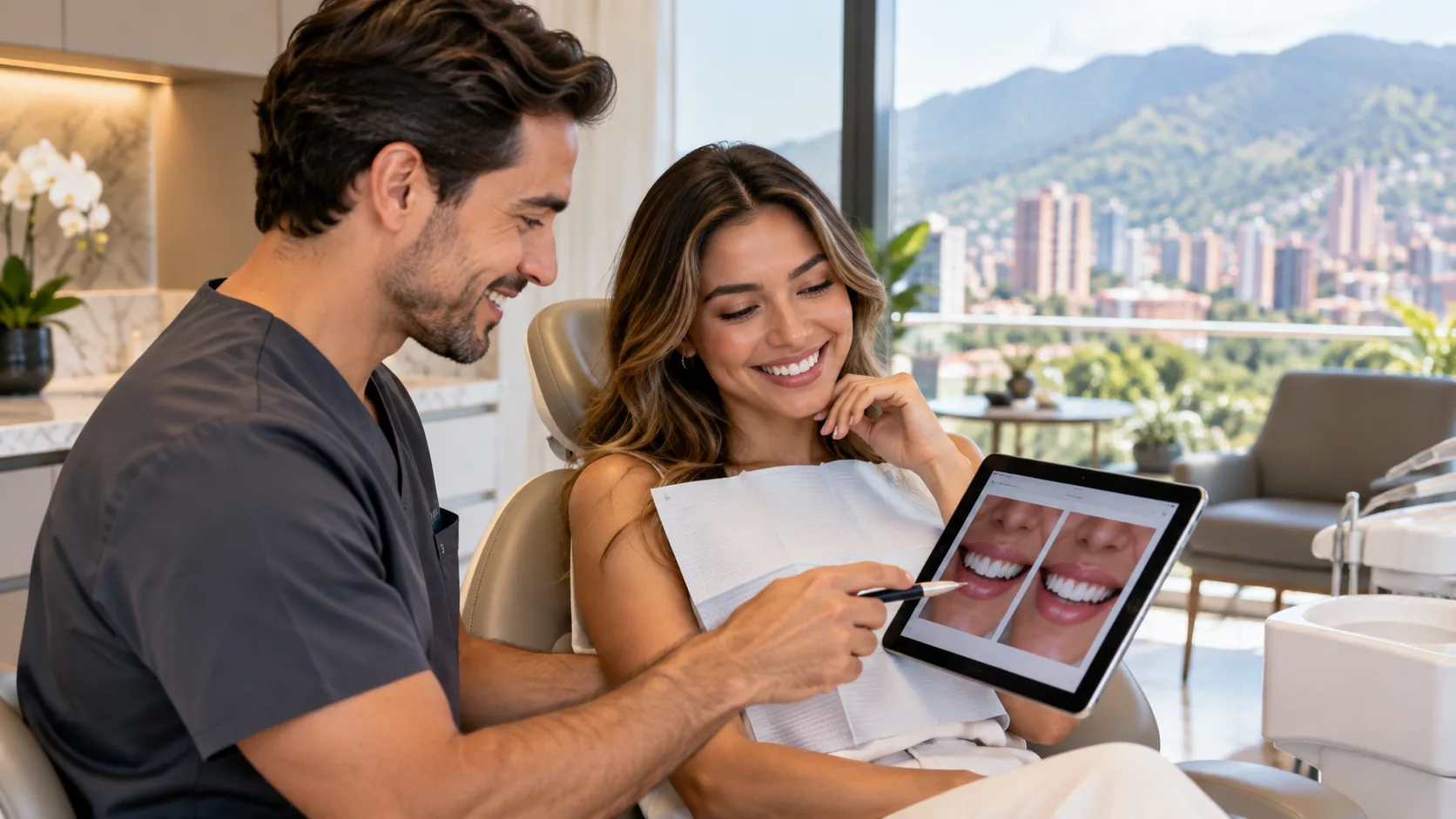
Many clinics also show a digital smile design on a screen: your face photo with new teeth overlaid. That is a helpful start, but a screen image cannot tell you how the teeth feel against your lips, how you sound when you speak, or how the smile looks from angles the software did not render. If you are offered only a digital preview, ask whether an in-mouth mock-up is possible.
Why it matters more when you travel
Patients who live near their dentist can return for tweaks over months. Travellers usually have a fixed window. Changes requested after veneers are bonded are harder, slower and sometimes impossible within the same trip. A mock-up front-loads the feedback into a stage where changes are just adjustments to a temporary material or a redesign by the lab.
It also creates a shared reference. "Make them look natural" means different things to different people. A mock-up turns vague words into something both you and the dentist can point at.
How to evaluate your mock-up: a structured check
When the mirror comes out, most people react to the overall impression and forget the details. Work through these areas deliberately, ideally over a few hours rather than a few seconds.
1. Length and edge position
- With lips relaxed and slightly apart, how much of the upper front teeth shows?
- When you say "fifty-five" or "Mississippi," do the edges touch your lower lip or catch?
- Does the curve of the edges follow your lower lip when you smile?
2. Width and proportion
- Do the front teeth look too square, too narrow or about right for your face?
- Are the side teeth visible as you smile, and do they blend into the back teeth?
- Does the centre line of the smile line up with the centre of your face?
3. Shape and character
- Are the corners rounded or sharp, and which suits you?
- Do you want the teeth perfectly even, or with slight natural variation?
- Do the teeth look like your teeth improved, or like someone else's teeth?
4. Feel and function
- Do your lips close comfortably over the teeth?
- Does anything feel bulky against your lip or tongue?
- Can you bite into something soft with your front teeth without strain?
5. Speech
Read a paragraph aloud and record yourself. Listen for whistling on "s" sounds or changes to "f" and "v." Small speech changes are common at first, but a mock-up is the right moment to flag anything that bothers you.
Live with it, if you can
Ask whether you can leave the clinic wearing the mock-up for a few hours or overnight. Seeing it in different lighting, at a restaurant, in a phone selfie and in candid photos taken by a friend gives you far more information than the dental chair mirror. Medellín's mix of bright midday sun and warm indoor light is actually a good test.
Take pictures from the front, both sides and slightly below, with a natural smile and a big laugh. Compare them with your "before" photos side by side. Many people find that a smile which looked perfect in the mirror reads differently in photos, or vice versa.
Giving feedback that changes the result
Dentists and lab technicians work in millimetres. "I don't love it" is hard to act on; "the two front teeth feel a touch long when I talk" is easy. Some tips:
- Be specific about which tooth and which direction: longer, shorter, wider, rounder
- Bring reference photos of smiles you like, especially of your own teeth from years ago
- Separate shape feedback from colour; the mock-up material may not match the final shade
- Ask the dentist to explain any change they advise against, and why
- Ask for a revised mock-up if the changes are significant
- Confirm the agreed design in writing or photos before preparation begins
Documenting the agreed design
Once you are happy, ask for the approved design to be recorded. That might be photos of the final mock-up, a saved digital design, or notes on agreed lengths and shapes. Keep a copy yourself. If anything about the final veneers looks different from what you approved, those records give you and the dentist a shared reference to work from, rather than relying on memory.
Colour is a separate decision
Mock-up materials typically come in limited shades, so do not judge the final colour from them. Shade selection is usually a separate step using shade guides and photos. If you plan to whiten your natural teeth, that typically comes first so restorations can match. The ADA notes whitening does not change veneers, crowns or fillings (ADA MouthHealthy, 2026), so anything you want lighter needs to be decided before restorations are made. Our guide Should You Whiten Before Veneers or Crowns? covers that sequence.
When a mock-up reveals a different plan
Sometimes the mock-up shows that the smile you want needs more or fewer teeth than planned, or that a tooth would have to be reshaped heavily to fit the design. That is the mock-up doing its job. Possible outcomes include:
| Mock-up shows | Possible conversation |
|---|---|
| Side teeth look dark next to new front teeth | Whether to include more teeth, whiten, or accept the difference |
| Teeth look too long when speaking | Shortening the design; checking the bite and lip position |
| One tooth sits far behind the others | Whether that tooth needs more reshaping, orthodontics or a different restoration |
| Gumline is uneven | Whether gum contouring would help before final restorations |
| Result looks bulky | Whether preparation is needed to achieve the shape with natural thickness |
If the plan changes, ask how it affects cost and timing. Changing the plan at this stage is far better than changing it after preparation.
Bringing someone you trust
Seeing your own face with new teeth can be disorienting. Many people find it helps to have a friend or partner at the mock-up appointment, or to share photos with someone at home whose eye they trust. An outside view is especially helpful for two things: spotting whether the result still looks like you, and noticing details you are too close to see, such as a slightly tilted centre line.
Keep the final decision your own, though. Friends may prefer a dramatic look you would tire of, or a subtle one that does not meet your goals. Use their feedback as data, then talk it through with the dentist.
Questions to ask the dentist at the mock-up
- How closely will the final veneers follow this shape?
- Which parts of this design would you change, and why?
- How much tooth preparation does this design require?
- Is there anything about my bite that limits the length or shape?
- Can I have photos of the mock-up for my records?
Fitting a mock-up into your trip
Ask the clinic where the mock-up sits in its appointment sequence. A common pattern is consultation and records, then design, then mock-up, then preparation. If design happens before you arrive, from photos and scans you send, the mock-up may come early in the trip. If design happens after your first visit, allow time for the lab. Our questions before veneers article has more on planning the clinical side.
Try not to schedule preparation the same hour you first see the mock-up. A night to sleep on it is a cheap form of insurance for a decision you will live with for years.
Frequently asked questions
Is a veneer mock-up the same as temporary veneers?
Not quite. A mock-up is usually placed before any tooth preparation to preview the design. Temporaries are placed after preparation while the final veneers are being made. Both may use similar materials.
Does a mock-up damage my teeth?
A mock-up is typically placed over unprepared teeth and removed afterwards. Ask the dentist how it will be placed and removed in your case.
Will the final veneers look exactly like the mock-up?
The final restorations are usually more refined, with better colour and translucency. Shape and proportion should follow the agreed design, which is why confirming that design in photos before preparation helps.
Is a mock-up included in the price?
It varies by clinic. When comparing quotes, list the mock-up as its own line item and ask each clinic whether it is included.
What if I don't like the mock-up?
Say so, as specifically as you can. Ask for adjustments or a revised design. You are under no obligation to proceed to preparation until you are comfortable with the plan.