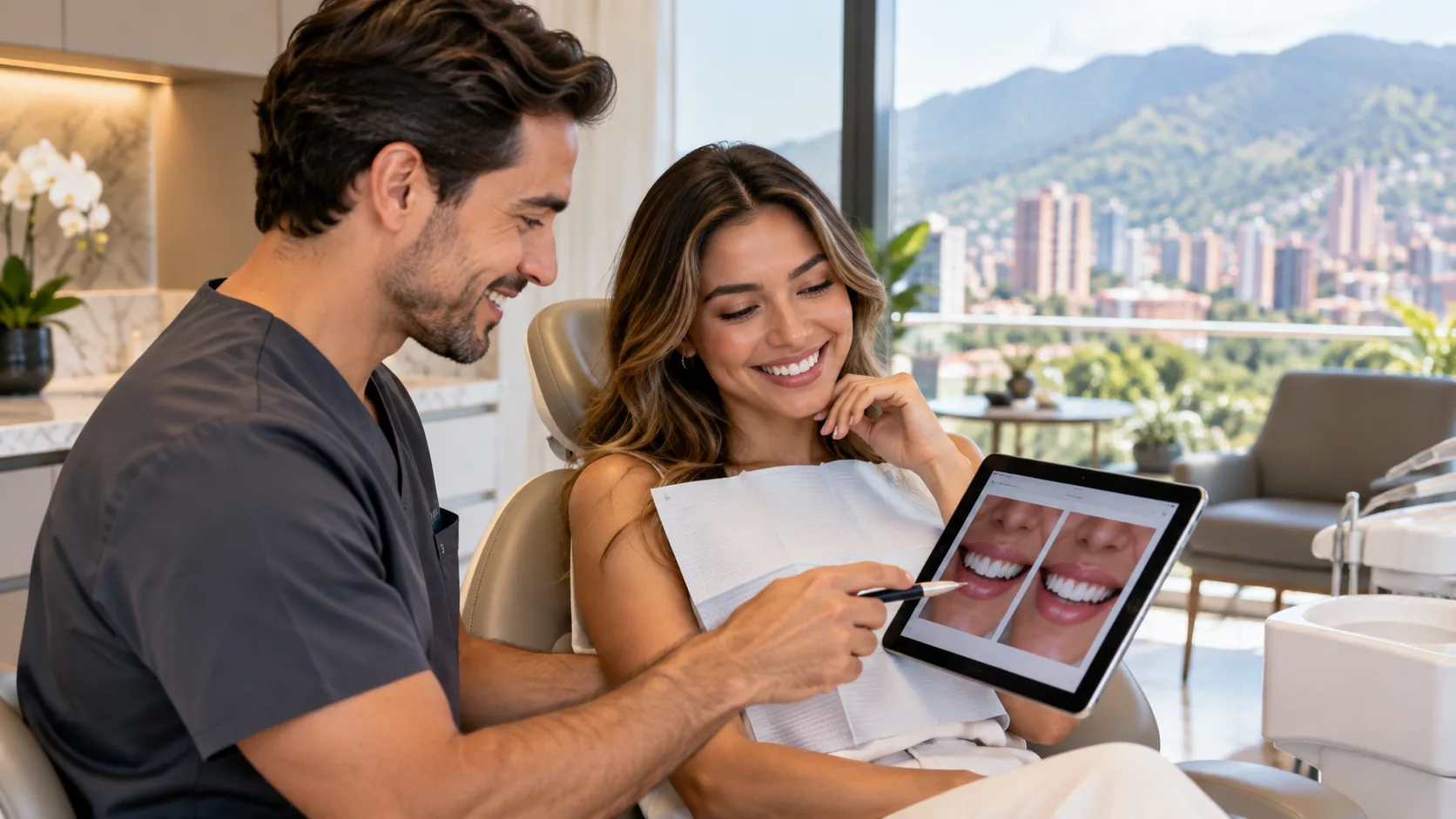
Of all cosmetic dental treatments, professional whitening is the easiest to slot into a visit to Medellín. There is no lab, no tooth reshaping and usually no recovery beyond a little sensitivity. Plenty of travellers add it to a trip they were already taking, or pair it with a dental checkup.
Still, "whitening" covers several quite different methods. Choosing between a chairside session and custom take-home trays affects how many appointments you need, how your days in the city look and what you carry home. This guide compares the options, explains what whitening can and cannot change, and offers practical ideas for planning.
If you are also considering veneers or crowns, the order of treatments matters. That specific question has its own guide: Should You Whiten Before Veneers or Crowns? This article is about whitening as a treatment in its own right.
How professional whitening works
Whitening products rely on peroxide, either hydrogen peroxide or carbamide peroxide. The ADA explains that these bleaching agents break stains into smaller pieces, making the colour less concentrated so teeth look brighter (ADA MouthHealthy, 2026). Stain-removal toothpastes are a different thing: they use mild abrasives to remove surface stains but do not change the tooth's underlying colour.
Professional options differ mainly in concentration, how long the gel stays on the teeth, and who applies it.
Option 1: in-office (chairside) whitening
The ADA describes in-office whitening as usually completed in a single visit. The dentist protects your gums with a gel or rubber shield, then applies the bleaching agent to your teeth (ADA MouthHealthy, 2026).
Why travellers like it
- Fast: a visible change in one appointment
- Supervised: a dentist manages the gel and protects soft tissues
- No trays to manage while you are moving around the city
What to weigh
- Sensitivity can be more noticeable after a concentrated session
- You may want a follow-up or take-home top-up to reach your target shade
- You need a checkup beforehand, which adds an appointment
Option 2: dentist-dispensed take-home trays
With this method, the dentist makes trays fitted to your teeth and tells you how much gel to use and for how long. The ADA notes this approach works more slowly, over a few days to a few weeks (ADA MouthHealthy, 2026).
Why it can suit a trip
- You can start in Medellín and keep going at home
- The trays can be reused later for top-ups, with your dentist's guidance
- Gradual whitening makes it easier to stop at a shade you like
What to weigh
- Trays have to be made and fitted, which needs at least two visits
- Results depend on consistent use
- Check the rules on carrying whitening gel in luggage, and in your home country; regulations on peroxide concentration vary between countries
Option 3: combination
Many dentists combine a chairside session to kick-start whitening with take-home trays to finish or maintain it. For travellers, this can be a practical middle ground: a visible start during the trip and a way to keep going afterwards.
| Factor | In-office | Take-home trays | Combination |
|---|---|---|---|
| Typical appointments | Exam plus one session | Exam plus tray fitting | Exam, session and tray fitting |
| Speed | Usually one visit | A few days to a few weeks | Quick start, gradual finish |
| Control over final shade | Less gradual | Very gradual | Flexible |
| Fits a short trip | Yes | If trays are ready early | Best with a few days |
| Maintenance at home | Separate plan needed | Trays already in hand | Trays already in hand |
Speed and method descriptions from ADA MouthHealthy (2026). Appointment counts are typical patterns, not fixed rules.
What whitening can't change
This is where expectations most often go wrong. The ADA lists several limits (ADA MouthHealthy, 2026):
- Whitening does not work on caps, veneers, crowns or fillings
- It is not effective on discolouration caused by medication or tooth injury
- Yellowish teeth usually respond well; brownish teeth may respond less; greyish teeth may not bleach at all
If you have tooth-coloured fillings or crowns on front teeth, whitening the natural teeth around them can leave the restorations looking darker. Ask the dentist to point out any restorations in your smile line before you start, so you can decide whether to accept a mismatch or plan to replace them later.
Sensitivity and safety
The most common side effect is sensitivity. The ADA explains that peroxide can pass through enamel into the dentin and irritate the nerve, and that this is usually temporary; you can pause and try again later. It also warns that overusing whitening products can damage enamel or gums (ADA MouthHealthy, 2026).
Practical steps to discuss with your dentist if you are prone to sensitivity:
- Mention any existing sensitivity, recession or worn areas at the exam
- Ask about desensitising toothpaste before and after treatment
- Consider shorter or spaced sessions rather than one long one
- Avoid very cold drinks for a day or two afterwards if teeth feel tender
Make sure whitening is done by or under the supervision of a dentist, after an exam that checks for cavities, cracks or gum problems. Whitening over untreated decay can be painful and does not address the underlying issue.
Planning whitening on a Medellín trip
Timing within your stay
Put the exam early in your trip. If cleaning or a filling is needed first, you will have time to do it before whitening. If you choose trays, the earlier they are made, the more of your treatment you can do under local supervision before flying.
Coffee country
Medellín is surrounded by coffee-growing regions, and a coffee tour is a popular day trip. Many dentists suggest going easy on strongly coloured drinks and foods for a short period after whitening. If a coffee farm visit is on your list, consider scheduling it before your whitening session or ask your dentist how long to wait.
Combining with other treatment
Whitening often pairs naturally with smile-makeover planning: some people find that whitening alone gets them close enough to skip restorations on some teeth. Others whiten first and then match veneers or bonding to the new shade.
Who whitening may not suit right now
Whitening is popular, but it is not the right first step for everyone. A dentist may suggest waiting or choosing a different approach if you have untreated cavities, cracked teeth, exposed roots from gum recession, very sensitive teeth or several visible restorations that will not change colour. The ADA also notes that discolouration from medication or injury tends not to respond well. In those situations, a frank conversation about bonding, veneers or simply cleaning and polishing may lead to a better result than chasing a shade that bleach cannot reach.
Keeping the result once you're home
The ADA's whitening page does not give a fixed duration for results, and in practice it varies from person to person. Diet, smoking and oral hygiene all play a part. A few habits help:
- Brush twice daily with fluoride toothpaste
- Rinse with water after coffee, tea or red wine
- Keep up professional cleanings at home
- Use trays for top-ups only as your dentist advises
- Look for whitening products with the ADA Seal if you use over-the-counter options
The ADA notes that its Seal on bleaching products means the product has been tested for safety and effectiveness in whitening (ADA MouthHealthy, 2026). If you are outside the US, ask your home dentist which products they trust.
Over-the-counter kits vs professional whitening
Some travellers wonder whether they should simply buy a kit at a pharmacy instead. The ADA notes that over-the-counter products use a less concentrated bleaching agent than dentists use in the office, and suggests discussing options with a dentist and looking for its Seal of Acceptance (ADA MouthHealthy, 2026).
The bigger difference, though, is the exam. A professional treatment starts with a dentist checking for decay, cracks, recession and existing restorations that will not change colour. Those are exactly the things that cause disappointment or discomfort with a kit used blindly. If you are already in Medellín for a checkup, a supervised treatment removes the guesswork. If you prefer an over-the-counter route at home later, ask the dentist which types of product suit your teeth.
A note on charcoal and "natural" whiteners
Social media is full of alternative whitening ideas. Before trying any abrasive powder or acidic home remedy, ask a dentist. Remember that the ADA describes stain-removal products as working on surface stains through mild abrasion rather than changing tooth colour, and that overusing whitening products can harm enamel or gums.
Questions to ask before booking
- Will I have an exam before whitening, and is it included?
- Which method do you suggest for my teeth and my length of stay?
- Do any of my existing fillings or crowns sit in my smile line?
- What concentration of gel will you use, and how do you manage sensitivity?
- If I take trays home, how should I use them and when should I stop?
- What results are realistic given my starting shade?
Frequently asked questions
Can I get teeth whitening on my first day in Medellín?
Possibly, if the clinic can examine you first and finds nothing that needs treating beforehand. Building in a day or two gives room for a cleaning or small repairs if needed.
Is in-office whitening better than take-home trays?
Neither is better for everyone. In-office is quicker; trays are more gradual and let you continue at home. Many people combine the two. Your dentist can suggest an approach based on your teeth and schedule.
Will whitening work on my tetracycline-stained teeth?
The ADA says whitening is not effective on discolouration caused by medication. Discuss alternatives such as bonding or veneers with a dentist after an exam.
Does whitening damage enamel?
Used as directed under a dentist's guidance, whitening is a common cosmetic treatment. The ADA warns that overuse can damage enamel or gums, which is why following instructions matters.
Can I bring whitening gel home on the plane?
Check your airline's liquid rules and the regulations in your home country, as rules on whitening products differ. Ask the clinic for packaging and written instructions.